
My thinking and learning around the ideas and concepts of self-advocacy is being nudged by the work I am doing supporting educators in their inquiry projects in a Graduate Program entitled, Supporting Diverse Learners. I have been explaining the importance of supporting their students in developing self-advocacy skills, and I have been sharing what I am learning from supporting my son, H, in his own self-advocacy journey.
I have been reinforcing that before they can advocate for themselves, their students need to develop self-understanding and a way to express that understanding. And then I have gone on to explain – particularly to the special ed teachers – that they will have to advocate within the school for these children. They will need to support the other teachers in developing the understanding to, in turn, support these students in their journey to advocate for themselves.
We have to be willing to ignore tone… and instead focus on intent.
Here’s the thing – sometimes when a child like H is stressed or overwhelmed and doing all that he can do to keep it together – and then is able to say what it is he needs – well, in that moment – very often the tone of his communication could be interpreted as rude or abrupt. This is difficult because I think adults have a tendency to just hear and respond to the inappropriate tone – instead of hearing the message.
I suspect we assign tone completely too much power:
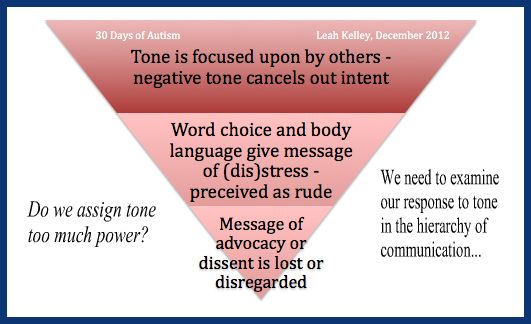
For many adults, this means that there exists unspoken rule or hierarchy of socially acceptable etiquette in terms of speech – and rude tone has the power to completely cancel out our willingness to listen.
I think we often to respond to the tone more quickly than to the content – and for our students with social communication issues – we need to be aware of our own tendencies to make unhelpful judgments. We, as educators (and parents too), need to open ourselves up to being more aware of the intent of the communication.
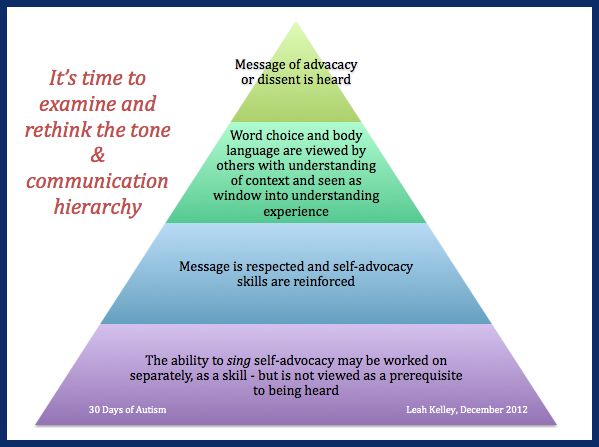
My son is learning to speak up for himself… but many times when he is at the point when he needs to do so, he has already begun to feel stressed or overwhelmed by a situation. At these times – H (and others) may not be able to state what he needs sweetly and politely.
H may not yet sing his advocacy… but just because he cannot sing his words… doesn’t that mean his voice should not be heard!
I know this is not easy.
Admittedly, I struggle still… and I am willing to reveal that I am perhaps – or rather, likely – a hypocrite. It seems a tricky messy thing to unwind the tightly tangled ball of teenager from self-advocate. It is a developmentally appropriate desire to disengage and to separate from one’s parents and begin to seek identity wholly one’s own. Rebellion – and sometimes cheekiness are typical – if rather unappreciated – but this is different from advocacy. H is working on the delineation of self; where he leaves off and others begin. At the same time, it is in this very space where he interfaces with the world, where he is working to embrace with pride the things about him that make him different, and have the self-understanding to be able to self-advocate.
Aaaack!! I certainly haven’t got this one figured out… but I am determined to work to honour the message of my child and strive to listen beyond the tone…
Related Posts: • The link between self-understanding and self-advocacy___________________________________________________
30 Days of Autism is a project designed to fight stigma, promote civil rights, and increase understanding and acceptance for those who process and experience the world differently.
© Leah Kelley, Thirty Days of Autism, (2013)



 Thirty Days of Autism