
 Navigating sensory issues, social stress and anxiety for children on the Autism spectrum can be a challenge at any time. However, I was recently asked by a parent for some tips or suggestions to help her Autistic child get through/handle a dinner event with extended family as this coming weekend is Canadian Thanksgiving (I know… not until November in the US).
Sitting down to the table at the large family dinner that often goes along with an event like Thanksgiving or Christmas can present a number of challenges for an Autistic child. This list is by no means exhaustive, but here are a few ideas that have worked for us. Most of them are centred around giving H a sense of control, a sense of ownership and belonging, and a vested interest in the event. Please feel free to comment and to add other suggestions as well:
• Give the child a quiet place to allow him/her to withdraw if needed: When H was younger… he drifted back and forth to the table when we had company… as the social aspects were overwhelming. We had Lego on the coffee table – so he could build and still be close by, but not in the thick of things. He could listen to the conversation and self-monitor/regulate his own level of involvement.
• Create a solo area to have some space away when visiting others: When we were at my parent’s house, we created a quiet area for H to withdraw and have time alone with books and favourite activities so that he could calm if needed and not feel that he had misbehaved.
• Involve the child in the preparations: I ask H to help set the table and we make it very fancy (still do this…) so he has a vested interest in what is going on at the table. During the day we collect colourful leaves and either make some kind of centerpiece or place a few on the table for a fall theme. This way H is proud to show off the table. If your child is an artist you might have him create place cards and help you decide who should sit where at the table.
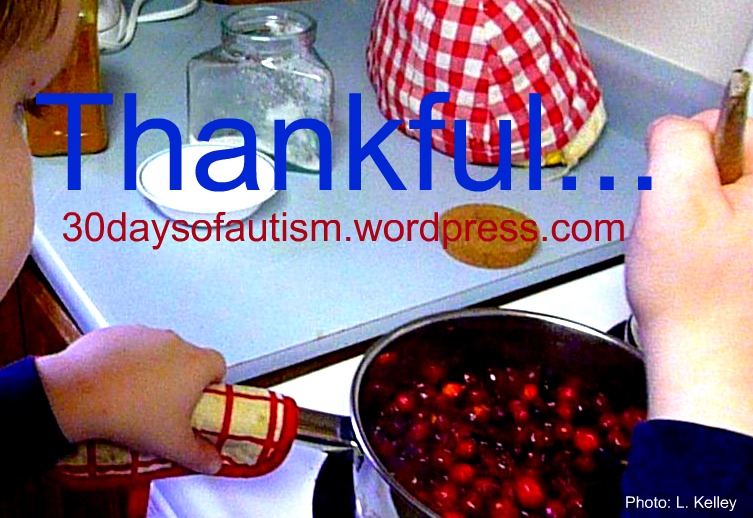
• Involve the child in creating and having a role in family traditions: H’s job is to make the cranberry sauce. This is such a simple cooking activity and it can be done a couple of days ahead of time. When H was very young he basically just helped me to stir the cranberries as they cooked – now he can pretty much do this task independently. H’s “famous” cranberries are another reason for him to feel like he is a part of things and included in the goings-on. He is proud of his contribution to the dinner and the sense of tradition that this is now his special job. Even though he won’t eat the stuff, he appreciates that everyone else loves his cranberry sauce. (By the way – H asked that I include that the secret to his recipe is to add a little cinnamon, lemon juice and orange rind…)
• Try to do as much of the preparation as possible ahead of time. I have to face it: cooking a turkey dinner is a lot of work – and if I am busy peeling potatoes or prepping brussel sprouts then I have considerably less time to focus on the needs of my child… let alone visit with guests. This much preparation can also be stressful and leave me wondering about how thankful I really am after various meltdowns (both mine and my child’s). Preparing early also removes the stress of the time factor – which allows for activities such as peeling potatoes or cutting up carrots to be a good opportunity to work with H on life-skills within a mentor/apprentice relationship.
• Ask for help: I don’t hesitate to ask others for help; family and friends are usually happy step in to lend a hand or to bring something along so that we just have to reheat it before dinner. This is just plain practical and I’m not ashamed to admit that even my own mother is not getting through the front door without either her broccoli salad or her amazing carrot cake in hand… Mmmmm!
• Give the child an important job during the transition to the table: We have H in the role of the director to invite our guests to the table. This gives him a sense of control and also makes it easier to join the group. He is most gracious and others have an opportunity to comment on his manners and include him in the conversation.
• Consider a plan for predictable conversation for a few minutes of the dinner time: We have started our own family tradition for both Thanksgiving and Christmas: each of us has a couple of moments to share and express what it is we are thankful for and we have H at the helm for this. He is the one who asks the question and “drives the bus” (as we call it), orchestrating who will have the next turn and making certain no one is left out. We are all along for the ride and in this way he is at the centre of the social interaction for a segment of the dinner, and he has the opportunity to use his social cognition skills.
• Be creative with other family events and activities that integrate the child’s developmental needs with the dinner time events. This is good because it also allows your guests to gain understanding and insight into your child’s abilities, strengths, and challenges. We created a perspective taking game for when we have one of those ridiculous centerpieces that is obviously too large and is blocking the view of the person across from you. We use that as an opportunity for H to imagine the perspective of others by asking the question: “Who is the flowerhead to ____?” H has to imagine the visual perspective of a person at the table and picture (from their perspective) who is across from them and being blocked by the centerpiece: that person is the flowerhead. We then check with the person to see if the perspective taker was correct. In my experience, younger children like to join participate in this as well. Seriously, this is only a two-minute activity – depending on the number of guests… so indulge and give it a try.
I am aware that what we are doing here is not exactly rocket science – but my point, ultimately, is that we have found ways to build traditions and our own family culture around simple yet meaningful interactions. This family culture of ours has built up over time, and it continues to change and evolve. To us this seems a perfectly natural and practical way to foster inclusion. For another family our ways might not be a fit, but whenever we are seeking to build connections and a feeling of belonging in a way that honours the needs of our children, we should take a moment to give thanks that we are likely on the right track.
___________________________________________________
30 Days of Autism is a project designed to fight stigma, promote civil rights, and increase understanding and acceptance for those who process and experience the world differently.
©Leah Kelley, Thirty Days of Autism (2011)



 Thirty Days of Autism