
I want to change something, sometimes I notice the littlest changes have the biggest impact.
In this post I am sharing my consideration of the significance and implication of the words “if” and “when”. Many years ago I stumbled upon this as a primary classroom teacher… so long ago actually, that I am unable to pinpoint when this knowledge came into being for me. Regardless, I have long been in awe of the power of these two little words and the shift in stance in terms of a relationship, or expectations within a relationship that the choice between these two words can convey.
If… or… When…
The word if is so amazingly potent: it can take a logical consequence and turn it into a threat or a power struggle with a child. For instance a child might ask, “Can I play a game on the computer?” and a parent might reasonably respond, “Yes, if you clean your room.”
Immediately the term if makes it sound like a bargaining issue or something to potentially be negotiated. Now I am not suggesting parents not negotiate occasionally with their children – but I certainly suspect that most of us are not feeling that we are lacking opportunity for this type of interaction.
Additionally, this little if can unintentionally turn our reasonable requests into subtly hidden threats to our children, “If you don’t _____ you wont get _____.” or “If you want to ____ you had better _____!”
Worse yet… it can lead us to nag or over-prompt.
For those of us with children on the Autism spectrum, we too often know the pitfalls of over-prompting, or alternatively, dealing with a child who has the stamina to argue even the smallest point with the persuasive conviction of a highly paid barrister.
My suggestion would be then to pretty much replace or substitute the word if with the word when. Any time we can do this as parents or as teachers, it removes a little bit of the potential for a power struggle, or the unintentional threat, and focuses on the desired behaviour in a positive and effective way.
“Can I go on the computer?
“Yes, when (not if) your room is clean you can go on the computer.”
“When you _______ , you will get ______.”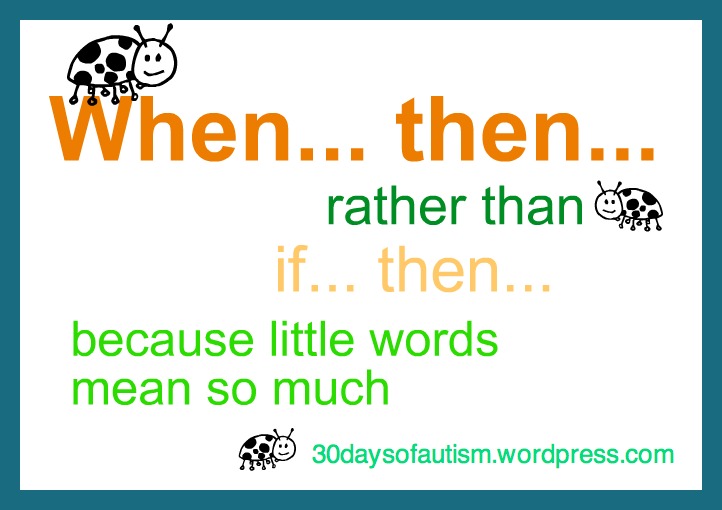
“When we finish _______ , we will ______.”
“When I can see you are ready, we will _____”
“When you finish your bath, we will have a story.”
So, after reading this you may consider giving it a try. You might be amazed. I will shamelessly admit that I am rather convinced that when has certain superpowers… and the difference in the dynamics of meaning, expectation, and relationship conveyed in simple word choice continue to astound me!
___________________________________________________
30 Days of Autism is a project designed to fight stigma, promote civil rights, and increase understanding and acceptance for those who process and experience the world differently.
©Leah Kelley, Thirty Days of Autism (2011)



 Thirty Days of Autism