
 I am not Autistic… though, H’s dad, the Amazing Craig, is. We are learning so much about ourselves from our experiences with H.
We are affected deep to our core – and we have learned amazing skills to use with our child, within ourselves as individuals, within our relationship, and in our broader movements in the world.
Being non Autistic doesn’t mean that I am not sometimes uncomfortable or awkward in social situations, but I usually understand the intent and motivation of others and I am able to understand differing perspectives with ease. I communicate well and I am well versed in reading non-verbal social cues, along with the underlying meaning of tone, nuance, and possible double entendre, and I am chronically addicted to irony.
It has been noted that I have some autistic shadow traits, tics, and attentional/focus challenges. I am happy to be alone and find too many people overwhelming. I can only handle the mall in 30 minute doses. I am good at social chit-chat for a short time – but I find it boring if it is lacking in substance, and I require recovery time from social gatherings. I have sensory issues, and OMG I have a difficult time remembering the names of people I see regularly.
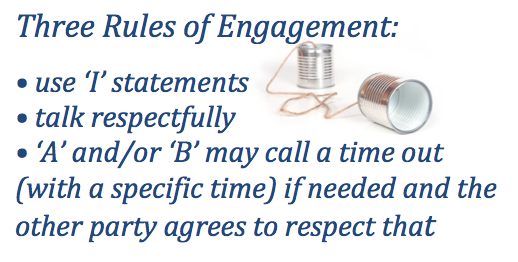
In my relationship with Craig, I have noticed that there can be a huge struggle with letting go of being positional. This can be the case in any relationship, of course, but I think it may be more of a challenge in an Autistic/non Autistic relationship. Being able to understand and reflect back each others’ point of view without feeling like the explanation will prove that one partner is in the right/the other in the wrong seems to be an important component. It is difficult to be in a place to understand the other view-point if you feel you have to protect yourself against an assault of sorts…. or just against having it pointed out that you were the one in the wrong (again).
There may be a tendency for Autistic adults to feel persecuted at times. As children and young adults the world may have come at them unevenly and it is also likely that their responses at times appeared uneven. It is understandable that if someone has grown up with social errors blowing up in their face, seemingly out of the blue, then they might be sensitive to criticism. Sometimes they may even perceive criticism when none is given or intended.
Perhaps thinking about an Autistic partner in this way might help us to support them in hearing our perspective – Sharing each others’ perspective can be a win/win scenario that brings partners closer together. It is interesting to watch the bluster of positionality fade out of someone’s fighting stance when they truly feel heard and understood by their partner. When this happens, they may find themselves in a place where it is much easier to listen to another perspective. And really – then it can be about understanding another’s perspective – rather than about who was right and who was wrong.
I checked with Craig before publishing this because I wanted to honour and respect him and his privacy. His response was that it was essential to post this article “because it will be providing a service to others.” He explained that although the reflective listening model has been something that we have had to overtly learn, practice, and rehearse – it has ultimately developed into a powerful relationship strategy.
“In fact,” he reminded me, “we had to use the model just last week.” and interestingly neither of us could remember what our disagreement was about: we just felt that the other listened and things had been resolved.
Craig explained, “It took the wind out of the sails of an adversarial stance without feeling fake – it’s not like some kind of Jedi mind trick or hypnosis. It takes the emotion out so that the rational can prevail and both partners move ahead feeling understood.”
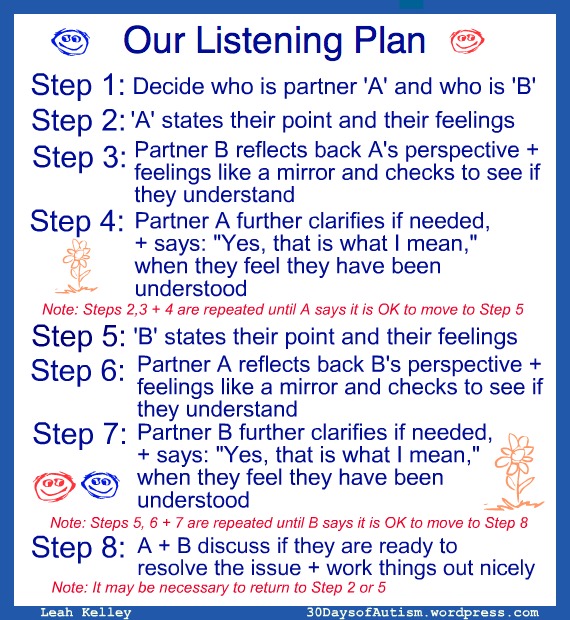
Below is a model of the reflective listening strategy that Craig and I use. It is not exactly rocket science – but it has really helped us learn to listen and understand each others’ perspectives. And hey… it’s visual! Gotta love that!!
___________________________________________________
30 Days of Autism is a project designed to fight stigma, promote civil rights, and increase understanding and acceptance for those who process and experience the world differently.
© Leah Kelley, Thirty Days of Autism, (2011)


 Thirty Days of Autism