As I am increasingly connected with people in Disabilities and Autistic communities, I am finding that there were things that in the past sat quite comfortably with me – that now – looking back – make me uncomfortable.
I sometimes feel like I would love to delete a whole bunch of posts, or at the very least reword them. I resist this, because I think it is important to be able to look back and be reminded of the shifts I have made. Almost invariably, those shifts have come from my friendships and connections with Autistic adults and from reading their work (which you can check out on my blog roll to the right ➜).
So ya… I am a work in progress…
One of the things that has been occupying my thoughts for the last while is the idea of intense interests or special interests. I have written about these before here and here and here.
I have stated that the potential for skill development embedded within a self-directed special-interest project is enormous.
I said:
When special interests are supported with opportunity…
…innovation, problem-solving, and positive development are inevitable!
~L. Kelley~
So… please… bear with me and I promise I will try to pull together the threads of my current thinking on this, because some of it has shifted.
It is important to support H’s interests and I believe that these are the foundational to so much of his development and also the satisfaction he finds in being who he is meant to be.
His interests renew him and soothe him and support his growth.
Deliberately and by design, we give H tonnes of time to spend exploring and pursuing his interests and to talk about them. We are interested and excited and share the excitement of his journey, and I find that I end up learning much about his current passions. Thus, I have an immense and detailed knowledge of things like Star Wars, Star Trek, retro pop culture, horror b films, and Zombies (to name but a few) that I might not otherwise have, and I am currently being schooled in Blacksmithing (and I am not being sarcastic).
H is at ease and is fueled by his interests, which is a part of the reason he is home-schooled, via a distance ed program. We believe it is important to protect his time and resources and to ensure he has the space and pace to delve into his interests and be as self-directed with these as possible. He is more communicative around his interests (as are we all) and his social interactions in the domains where these can be found (ie: skulking in a thrift shop) are relaxed and confident.
I also resist the tendency to formalize the teaching or training around his current interests, as this sort of meddling seems to squelch them. I want him to be at the helm. I would suspect that a typically developing non Autistic teen, who is showing an aptitude with building or making movies or learning to work with metal, might be enrolled in some sort of more formalized instruction. This is not useful at this time for H, though I’m not saying it wont be at some later point.
His learning seems to happen more organically – and holistically – through a total immersion in his current interest.
He is an inventor.
He is a blacksmith…
or a Jedi..
or a Hobbit…
absolutely and completely…
It is beautiful really.
Throughout his childhood, and as he is transitioning to adulthood, I have been unfaltering in my support of my son’s interests (even though at times I’m admittedly in quite over my head). However, it as I am considering this in the context of ableism, that it seems I may have missed something here… and it is dawning on me that this may be something big!
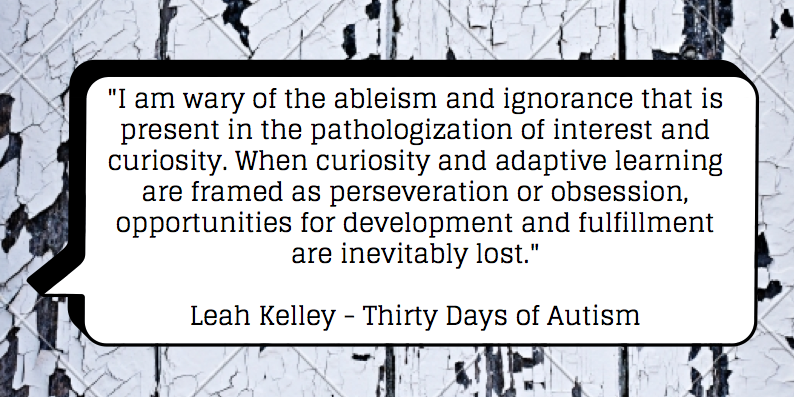
Image Description: Wooden fence with peeling paint frames a large speech bubble. Test reads: ” ‘I am wary of the ableism and ignorance that is present in the pathologization of interest and curiosity. When curiosity and adaptive learning are framed as perseveration or obsession, opportunities for development and fulfillment are inevitably lost.’ Leah Kelley – Thirty Days of Autism”
I have long considered that there is ableism and ignorance in the pathologization of interest and curiosity, when it is framed as perseveration or obsession, and I rejected this stance even before I could talk about it in such terms.
However, I am now seeing an aspect that I hadn’t considered. I am understanding with more depth that I must be wary of less obvious (to me at least) language that pathologizes strengths, such as curiosity and adaptive learning, by framing these in a way that potentially reinforces stigma.
So many times I have unquestioningly adopted language that is prevalent and commonly used to describe the interests of Autistic people – like my son – and I am now wondering if there are elements (once again) that I need to question as potentially disrespectful and problematic.
So here’s the thing… I am considering/reconsidering the use of the word ‘special’ when referring to interests, because I am wondering if that is dismissive and diminutive for this young man who is very rapidly approaching adulthood.
It feels uncomfortable to me… or perhaps more it makes me uneasy. Though I am not certain that term captures what I want to say, uneasy may be the best word I have at this time, though I would like a word that also layers in curiosity and a reluctance to come to a definitive conclusion. An uneasy wondering perhaps… because, if I would not describe the interests of non-Autistic person in such a way… then this is something I feel I need to question.
When I asked H how he felt about the use of the term special interest, he said: “I would rather it just be an interest. I don’t like the way people use the word ‘special’ in all sorts of ways to mean I am different. I think special is another way of saying you’re less than.”
Then before he went back to his current project he added, “That’s all I’ve got.”
Of course, this is personal; it is specific to our situation and reflective of my process and of my son’s response to my wondering. In a way, this is also a microcosm of something bigger: a glimpse into my own continuous journey of letting go and of supporting this wonderful young man on the next part of his development. I am willing to own this, but also want to clarify that I am by no means suggesting that the word ‘special‘ in relation to interest should not be quite comfortably used by others if that suits them. Neither am I suggesting that ‘special’ be added to a list of ableist language that has to be the same for everyone… but in this context – for my son – and for me – this is clearly the case.
I will continue to support H’s development and the beauty of the intensity of his interests and curiosity that drives his self-directed learning, and to celebrate his explorations and his inventiveness, but I will no longer be referring to these as ‘special‘… at least not until we refer to everybody’s favourite topics, interests, or activities that way, and/or he indicates a shift in his own feelings about this.
I expect I will continue with my uneasy wonderings about things I haven’t closely examined when I have to opportunity to see from a different angle… because so often I discover something I’ve missed, and I have much to learn.

“Blacksmith Joy” Image of H wearing jeans and a Don’t Get Bit zombie t-shirt in a garage strewn with projects and tools. He is holding a 3 lb cross peen hammer and is about to strike the blade of a metal broadsword that is he is holding with his other hand against a work bench. He is looking downward at the project with concentration and confidence.
Please check out this beautiful related post:
Self Care Looks Like “Special Interests” By Michelle Sutton _________________________________________________
30 Days of Autism is a project designed to fight stigma, promote civil rights, and increase understanding and acceptance for those who process and experience the world differently.
© Leah Kelley, Thirty Days of Autism (2015)


 Thirty Days of Autism