As adults we must hold space for young people, and nurture their sense of identity and caring for the world, so that there is room and opportunity for all their wild and wonderful imaginings… and so they can make the world their own.
The future is not really ours to be imagined – it belongs to our children…
Stay grounded
Take the one next step
take it firmly and with confidence
this is the part we can control…
with deliberation
Deliberately
liberatingly
with trust
in our capacity
as we hold close
our understanding
of possibility
It is the path of our children
that we are laying down
A holding of space
on a borrowed path
Shared praxis
deliberate space
and pace
to accept them as they are
a liberating place
for our children
to be their authentic selves
Gloriously
joyously
at the helm
self-determining
living their lives
stepping into their own
emergence
Stay grounded
Take the one next step
take it firmly and with confidence
this is the part we can control…
with deliberation
Deliberately
liberatingly
with trust
in our capacity
as we hold close
our understanding
of possibility
It is the path of our children
that we are laying down
A holding of space
on a borrowed path
Shared praxis
deliberate space
and pace
to accept them as they are
a liberating place
for our children
to be their authentic selves
Gloriously
joyously
at the helm
self-determining
living their lives
stepping into their own
emergence
Leah Kelley (2018)
Poem from The Person Who Arrives: Connecting Disability Studies to Educational Practice for Teachers, Parents, and Others, p. 173, Kelley, L., 2023
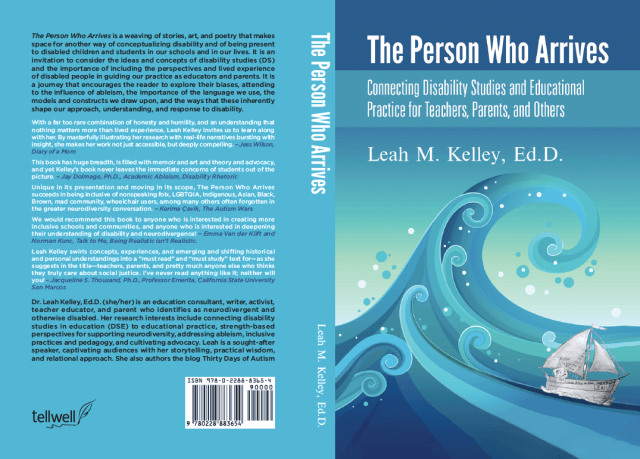
Image: The Person Who Arrives: Connecting Disability Studies and Educational Practice for Teachers, Parents, and Others. Flattened front, back, and spine of book cover with teal background. Front cover: Image is a series of teal to blue coloured playfully curling waves with round teal and white circles scattered, like sea foam or bubbles. On the lower right side is a pencil sketched sailboat, riding the largest of the waves. The boat is drawn in the style of Sendak, depicting a frizzy haired person in a wolf suit with hands on their hips. On the side of the boat is the query, “Whose Story is this anyway…” and inscribed with a name “LEAH.” White text on darker teal at the top of the page reads: “The Person Who Arrives” White text below on lighter teal reads: “Connecting Disability Studies and Educational Practice for Teachers, Parents, and Others” and “Leah M. Kelley, Ed.D.”
Spine: White text on a teal background reads: The Person Who Arrives, Leah M. Kelley, Ed.D.” Back
Cover: Black and white text on teal read as follows: The Person who Arrives is a weaving of stories, art, and poetry that makes space for another way of conceptualizing disability and of being present to disabled children and students in our schools and in our lives. It is an invitation to consider the ideas and concepts of disability studies (DS) and the importance of including the perspectives and lived experience of disabled people in guiding our practice as educators and parents. It is a journey that encourages the reader to explore their biases, attending to the influence of ableism, the importance of the language we use, the models and constructs we draw upon, and the ways that these inherently shape our approach, understanding, and response to disability.
With a far too rare combination of honesty, humility, and an understanding that nothing matters more than lived experience, Leah Kelley invites us to learn along with her. By masterfully illustrating her research with real-life narrative bursting with insight, she makes her work not just accessible, but deeply compelling. – Jess Wilson, Diary of a Mom
This book has huge breadth, is filled with memoir and art and theory and advocacy — and yet Kelley’s book never leaves the immediate concerns of students out of the picture. – Jay Dolmage, Ph.D., Academic Ableism, Disability Rhetoric
Unique in its presentation and moving in its scope, The Person who Arrives succeeds in being inclusive of nonspeaking folx, LGBTQIA, Indigenous, Asian, Black, Brown, mad community, wheelchair users, among many others often forgotten in the greater neurodiversity conversation. – Kerima Çevik, The Autism Wars
We would recommend this book to anyone who is interested in creating more inclusive schools and communities, and anyone who is interested in deepening their understanding of disability and neurodivergence! – Emma Van der Klift and Norman Kunc, Talk to Me, Being Realistic isn’t Realistic.
Leah Kelley swirls concepts, experiences, and emerging and shifting historical and personal understandings into a “must read” and “must study” text for – as she suggests in the title – teachers, parents, and pretty much anyone else who thinks they truly care about social justice. I’ve never read anything like it; neither will have you! – Jacqueline S. Thousand, Ph.D., Professor Emerita, California State University San Marcos
Dr. Leah Kelley, Ed.D. (she/her) is an education consultant, writer, activist, teacher educator, and parent, who identifies as neurodivergent and otherwise disabled. Her research interests include connecting disability studies in education (DSE) to educational practice, strength-based perspectives for supporting neurodiversity, addressing ableism, inclusive practices and pedagogy, and cultivating advocacy. Leah is a sought-after speaker, captivating audiences with her storytelling, practical wisdom, and relational approach. She also authors the blog, Thirty Days of Autism.


 Thirty Days of Autism
Reblogged this on Melissa Fields, Autist.
LikeLike
This is lovely. Thank you.
LikeLike