
I started writing this when we were camping last month… on day 3 of 5:
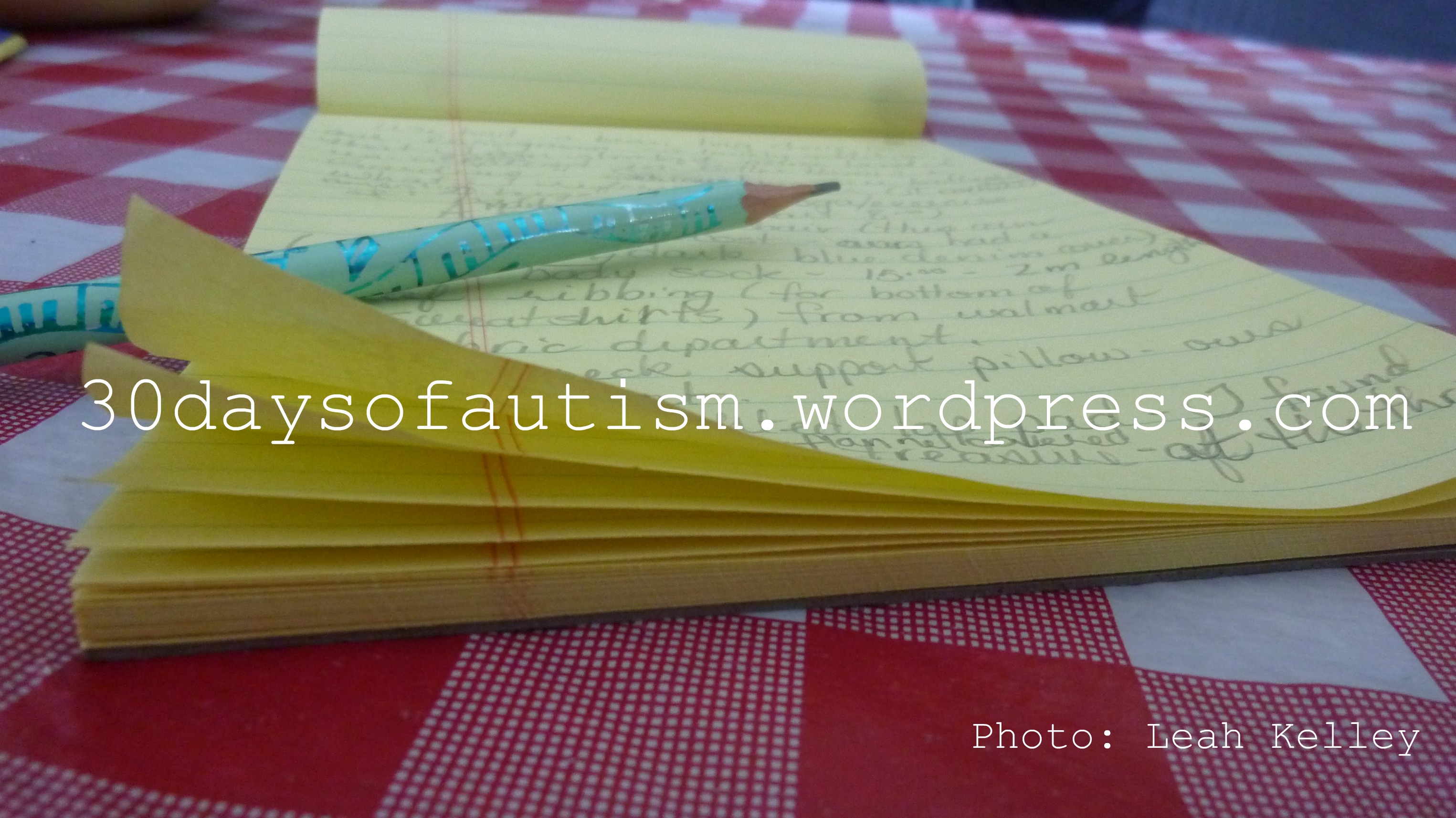
I am falling into a certain relaxed rhythm. I still have my coffee and now I am writing with a knife-sharpened pencil on a mini yellow legal pad. I am unplugged.
I have been reading John Elder Robison’s new book, be different: Adventures of a Free-Range Aspergian. I was inspired by his previous book: Look me in the eye: my life with aspergers, and I have been eagerly waiting for a space and place where I could settle down to consume his latest work relatively uninterrupted. Robison’s new book is an insightful peek into the perspective of an adult with autism. There have been parts when I sighed, nodding, open-mouthed: Aaahhhhh – I see! As I read it, I am encouraged that we are on the right path with H. I don’t mean the perfectly right path as there is likely no such thing – or if there is it eludes us still. I am fine with that. As I have said before, as parents The Amazing Craig and I are a work in progress.
I have just finished part 4 of be different. Page 165 begins the chapter “Underwear with Teeth” in which Robison shares his experiences, thoughts, and strategies for dealing with sensory issues. What really struck me was his questioning of the wisdom of cutting tags out of clothes, or trimming seams for kids to reduce the sensory overload. He explains:
“Today I meet moms who cut the labels out of their kid’s clothes and trim the seams. The first time I heard this, it sounded great. What a nice thing to do, I thought. But when I thought about things a little more, I began to question the wisdom of that. Why? Because removing the irritants doesn’t do anything to decrease our sensitivity. And if clothes tags bother us today, and we don’t address the nuisance head-on, where will we be in ten years? Naked at work?
Instead of fixing my clothes, I fixed myself. I learned to focus my mind so that my sense of touch no longer controlled me…”(be different, page 167)
Robison goes on further to explain that it was a more complex process than to simply ignore the sensory issues, but his perspective is certainly worth more than passing consideration. I have written previously about resiliency, anxiety, and learning to handle discomfort. (Coping with Anxiety…).
More than this however, Robison’s point has me reflecting back on my own child’s considerable sensory issues. We realized that H had sensory challenges before we ever even considered that he might be autistic. We began to work with him when he was 3 to address his sensory needs, and I found Carol Stock Kranowitz’s book, The Out-of-Sync Child, an invaluable resource. When he was finally evaluated at Children’s Hospital (almost 3 years later), the OT (Occupational Therapist) affirmed that H had “serious problems with Sensory Integration Dysfunction and that it was unusual seen a child with such marked disruptions across so many of the domains…”
We were told that Sensory Integration Dysfunction (now termed SPD: Sensory Processing Disorder) is best treated with a “balanced sensory diet.” H was sensory seeking in many domains, and sensory avoiding or tactile defensive in others.
Here are a few of the things we did to address his sensory needs – and I must admit that we found economical, practical, and effective ways of doing so.
H was one of those kids who responded well to deep pressure:
• When he was around 3 years old, we had a pillow tent in his room. This was an inexpensive pop-up style tent that we filled with pillows and stuffed animals. So he was able to burrow into his stuffies when the world got to be too much and the closeness of the area calmed him. During the day we just lifted the tent onto his bed so that he had room to play, and we moved it back onto the floor at bedtime.
• When we went to a social event at Grandma and Papa’s (at times very overwhelming) we made a sensory safe place away from home by putting pillows in Grandma’s en suite bathtub. (Note: H was not one of those kids who ever got into stuff – so we were comfortable with this.) We wanted him to begin to self-monitor and self-regulate and be able to remove himself or ask for time apart if he needed it, without feeling like he was in trouble.
Heavy work settled H:
• I would have him carry a heavy item from the groceries (like a case of pop) to the car on the occasions that he came on a short shopping trip, and I still do this. He loved to drag big logs around at the beach and in the woods… he still does!
• He also calmed when digging with a shovel, and vacuuming (ah… I miss those days) so we tried to make lots of opportunities for these kinds of activities.
• When he was 4 or 5, Craig used to set him up with an old brick in the backyard, complete with safety goggles, a cold chisel, and a hammer and he would break up an old brick and then sweep and vacuum with the shop vac. He could really go to town and he is the kind of guy who loves LOVES using tools.
• He would wear a backpack weighted with books on outings. Books were a great choice because hearing stories additionally calmed him. H often came home from school with rocks overflowing in his coat pockets… In retrospect – I think he was creating his own weighted clothing articles.
So I suppose I must agree with Robison’s general premise about learning to handle discomfort. I think that as parents of these amazing and unique children, we are always working to balance our interventions with the child’s current ability and needs and we as we are also considering whether our strategies are creating difficulties rather than diminishing them. This is indeed a tricky place to be, and it often has us observing and re-assessing our responses and attitudes. I think that is OK: we don’t always get it right the first time. We are very pragmatic – and if we need to change a plan or a strategy – we will most certainly do so. Nevertheless, our experience has been that providing H with a balanced sensory diet has really assisted him in integrating his sensory experiences and processing ability.
We found/created many other inexpensive and practical ways to address H’s sensory needs and to help him work toward integrating his sensory system more effectively… And I will be going into more depth with those strategies and ideas in: Providing a Practical Sensory Diet: the second course …coming soon to an autism blog near you!!
 ___________________________________________________
© Leah Kelley, Thirty Days of Autism, (2011)



 Thirty Days of Autism