
 My friend E wrote this wonderful piece and has generously given her permission for me to publish it here as well. I love E’s message for so many reasons, one of which is the self-understanding and strength amplified in her statement: “I am 24, and I am autistic, and my choices reflect what I need to do to interact with the world.”
This is the third post in E’s April Autism Acceptance Series. You can find more of her work on her blog, The Third Glance.
April Autism Acceptance series #3: “Age Appropriate” play and toys
April 3, 2014
One of the things I see most often when I poke around in autism parent forums, is the concern that their child isn’t playing with “age appropriate” toys or doesn’t have “age appropriate” interests. This, to my eyes, is one of the most ridiculous questions to be asking, and in a way, really shows how far we have to go for autism acceptance. The whole idea of “age appropriate” kind of bothers me, because numerical age is such a misnomer anyway, since everyone develops on a different trajectory. But I digress. The thing is, what is the point of toys? When you’re a little kid, there are two major purposes that a toy serves. The first is play. The second is learning and development of some sort. But really, what is the point of a toy? It is to make a person happy and enjoy themselves. Sometimes toys are for comfort. Sometimes they are for a challenge.
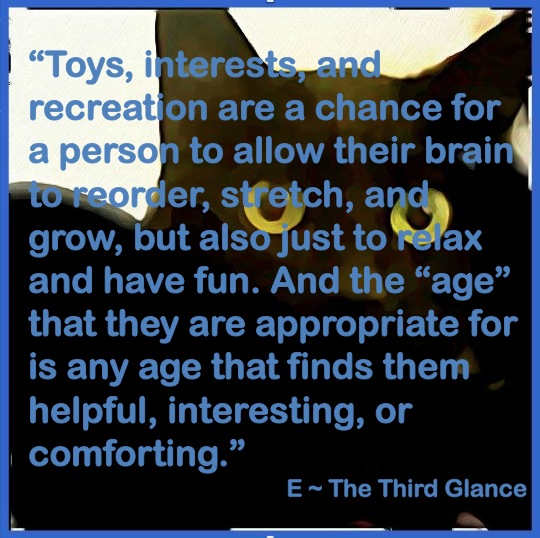
In a world where every movement, every interaction, every sound, light, and texture is a challenge, I seek comfort where I can. I didn’t have hours of therapy when I was younger, but I can imagine that for children who do, the hours of therapy only increase the challenges they face on a daily, even hourly basis. Is it any wonder that when given the opportunity to do something of their own choice, they choose something that they find comforting? There’s only so much that my brain can stretch for a day. For some people, that comfort comes in watching train videos on youtube. For others, it involves hours of scripting Dora the Explorer. For others, it is lining up toys instead of doing the “intended” thing with them. Play and toys are more than a learning and developmental tool. There’s more than one “right” way to do something with toys. I would hesitate to say there are any “right” ways to play with something. Toys, interests, and recreation are a chance for a person to allow their brain to reorder, stretch, and grow, but also just to relax and have fun. And the “age” that they are appropriate for is any age that finds them helpful, interesting, or comforting.
I will tell you, that as a 24-year-old woman, I still have all of my stuffed animals, and I snuggle with them on my bed every night. I take one with me many days of the week, especially when I’m not feeling good. I love watching Disney movies. I read and greatly enjoy books written for young teenagers (though by no means are these the only books I read). I don’t find things my age-peers do for fun (going to bars, watching drama-based TV/movies) particularly interesting or compelling. And in my eyes, that is perfectly fine. It is what makes me, me. I choose to challenge myself intellectually, all day at work. But I also choose comfort. When I come home, I choose to read things I have read tens or hundreds of times before. I choose to cuddle my stuffed animals. I choose to watch movies and TV with simple but elegant plotlines that I have watched numerous times before. I am 24, and I am autistic, and my choices reflect what I need to do to interact with the world.
So Parents, next time that you worry that your child isn’t playing with “age appropriate” toys or doesn’t have “age appropriate” interests, just remember this. The age on the package means nothing. Toys and interests have many purposes, and your child is enjoying themselves doing what they love to do. Acceptance isn’t settling for the idea that your child likes strange things that are different from their peers interests. Acceptance is recognizing that there is intrinsic value in someone’s interests, no matter how different from the perceived “normal”, and reveling in that knowledge and understanding.
__________________________________________________________
E’s insightful writing is a part of the body of work by Autistic writers and advocates that has informed my parenting and my practice as an educator. I am committed to supporting and amplifying these important voices and perspectives in a number of ways, one of which is sharing and promoting their work through social media, and I once again encourage readers to check out the blog roll to the right –>
In terms of E’s writing, I particularly recommend the blog’s namesake post The Third Glance as a starting place. E says, “This post was the first. It is an essay about invisible disability, passing, (anti)bullying… Please, if you’ve only got 10 minutes, this is the one to read. Because everyone deserves the third glance.”
I concur!
Thank you, E ♥
___________________________________________________
30 Days of Autism is a project designed to fight stigma, promote civil rights, and increase understanding and acceptance for those who process and experience the world differently.
© Leah Kelley, Thirty Days of Autism (2014)



 Thirty Days of Autism